
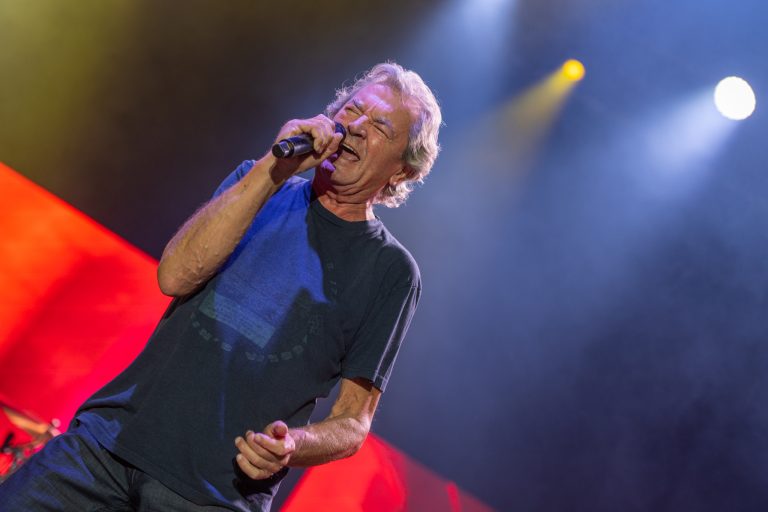
Ian Gillan helped define the sound of Deep Purple, played Jesus on the original recording of Jesus Christ Superstar and made an album with Black Sabbath. Between those projects, he built a discography of his own that ranges from jazz-rock to more direct hard rock. His high notes became famous, but they tell only part of the story.
There is a moment on Made in Japan when the distinction between singer and instrumentalist almost disappears. During “Strange Kind of Woman”, Ritchie Blackmore plays a phrase on guitar and Gillan answers with his voice. The exchange continues, the phrases change and the difficulty increases. What might have been a display of vocal range becomes a musical conversation: they listen to each other, trade challenges and seem curious to find out how far they can go.
That passage reveals more about Gillan than any ranking of great singers. It captures his ear, his humor, his appetite for risk and his ability to improvise within a band that was also improvising. The album brings together performances recorded in Osaka and Tokyo in August 1972, with Blackmore on guitar, Jon Lord on keyboards, Roger Glover on bass, Ian Paice on drums and Gillan on vocals.
His phrasing, diction and freedom to sound restrained one moment and unhinged the next deserve as much attention as his high notes. To understand how he developed, we need to return to the years before Purple.
From Hounslow to Episode Six
Ian Gillan was born in Hounslow, England, on August 19, 1945. His early influences included Elvis Presley and Little Richard. That connection to early rock helps explain a lasting feature of his music: even when the sound grows heavy, there is room for mischief, movement and fun.
Before the big stages came the Javelins and then Episode Six, where he met Roger Glover. His apprenticeship involved vocal harmonies and demanding runs of club appearances. In an interview published by The Strange Brew, Gillan recalled playing successive shows in Germany and the band’s stint in Lebanon. He learned his trade by singing night after night.
When Gillan and Glover joined Deep Purple in 1969, they already shared a musical history and a songwriting partnership. They encountered three musicians with distinctive personalities: Blackmore’s incisive guitar, Lord’s organ and Paice’s drums. This lineup became known as Mark II, the band’s second incarnation.
Purple had already recorded “Hush” with singer Rod Evans. Gillan’s arrival coincided with the group’s move toward a heavier sound. His singing had the presence to stand alongside the instruments and the flexibility to join their improvisations.
In Rock, Machine Head and Made in Japan
On In Rock, released in 1970, “Speed King” and “Child in Time” offer two portraits of the singer. The first brings rock ’n’ roll to an almost feverish pitch. The second builds through anticipation, repetition and a gradual rise in intensity.
“Child in Time” is often treated as an endurance test for singers. That approach misses a central quality of the performance: the distance between its quiet opening and its eruption. Gillan holds the listener’s attention at low volume, gives purpose to the repetitions and makes each ascent feel necessary.
The high notes carry the accumulated tension. Removed from the song, they would be an athletic feat. Within it, they become part of the drama. The 1970 performance preserved on the Deep Purple Official channel lets viewers follow that progression and watch the Mark II lineup at work.
After Fireball, released in 1971, Machine Head, released in 1972, put his voice into songs with very different characters. On “Lazy”, his singing moves with the band’s groove and slips between instrumental phrases. On “Highway Star”, his delivery is direct, matching the song’s momentum and lending conviction to its fantasy of speed.
“Smoke on the Water” calls for a different approach. Its riff dominates popular memory, but the verses have a story to tell: the fire during a Frank Zappa concert in Montreux and the difficulties that followed as Purple tried to record the album. Gillan delivers the account without turning every line into a demonstration of power.
Made in Japan, released in 1972, documents what happened when that repertoire reached the stage. The arrangements expand, requiring the singer to listen and respond. His exchange with Blackmore on “Strange Kind of Woman” shows how much of an instrumentalist there was in his approach to singing.
Gethsemane and Jesus Christ Superstar
During his first period with Purple, Gillan played Jesus on the original album of Jesus Christ Superstar, by Andrew Lloyd Webber and Tim Rice, released in 1970. His performance belongs to the studio recording that introduced the work, before the 1973 film.
According to Gillan, Rice had heard his work with Purple and invited him to learn about the project. During preparations, Lloyd Webber played the melody on piano. Gillan was encouraged to retain his own singing style and improvise while respecting the composition, as he told The Strange Brew.
“Gethsemane” asks its performer to move through doubt, anger, fear and acceptance. Gillan gives those changes a physical intensity. The roughness in his voice makes the character sound exposed; the highest passages grow out of a conflict already present in the earlier lines.
Hearing this recording alongside “Child in Time” makes the dramatic dimension of his singing clearer. He knew how to build a crisis within a song. Vocal power was one of the means he used to do it.
Ian Gillan Band and Gillan
His first period with Deep Purple ended in 1973. In a retrospective account revisited by Classic Rock, Gillan described a strained relationship in which the members traveled and ate separately, meeting mainly to work. It is the singer’s account of the cost of a routine that, from outside, appeared to represent the band’s peak.
His subsequent work deserves attention in its own right. Ian Gillan Band and Gillan were separate projects with different approaches and lineups. On Clear Air Turbulence, released in 1977, Ian Gillan Band moves toward jazz-rock, allowing room for extended instrumental passages and changes of atmosphere. The album’s master entry on Discogs reflects that combination of hard rock, progressive rock and jazz-rock.
With Gillan, the music becomes more direct and aggressive. Mr. Universe, released in 1979, includes “Vengeance” and “Roller”, both co-written by the singer. Those credits are a reminder that he also helped shape the songs themselves.
On Glory Road, released in 1980, the band features a particularly interesting lineup: Bernie Tormé on guitar, John McCoy on bass, Colin Towns on keyboards and flute, Mick Underwood on drums and Gillan on vocals. These are the musicians identified in the credits of the edition consulted on Discogs.
“Unchain Your Brain” displays the group’s speed and aggression. “No Easy Way” and “If You Believe Me” give the singer other settings to explore. There is a rough energy to these records, with less solemnity than one might expect from a former member of such a huge band.
Born Again and the return to Deep Purple
In 1983, Gillan recorded Born Again with Black Sabbath, alongside Tony Iommi, Geezer Butler and Bill Ward. The band had already been through Ozzy Osbourne’s dismissal in 1979 and its albums with Ronnie James Dio. Gillan was joining a group whose vocal identity had already changed substantially.
Iommi’s guitar creates a density different from Purple’s. Gillan responds with restless, cutting and sometimes excessive singing. On “Trashed”, that friction suits the track’s pace. On “Disturbing the Priest”, his vocal theatrics make the atmosphere stranger still. Iommi’s own website acknowledges the divided response to the album’s production.
The brief spell with Sabbath was followed by the reunion of Deep Purple’s classic lineup for Perfect Strangers, in 1984. Its title track presents a lower, more restrained Gillan, able to sustain the song’s atmosphere without relying on the rush of the early records.
He was dismissed from Purple in 1989 and returned in 1992. The reunion with Blackmore produced The Battle Rages On…, released in 1993, but the relationship did not last: the guitarist left that year. Gillan stayed and took part in the Steve Morse era, including Purpendicular, released in 1996. The story continued beyond attempts to keep the 1970s lineup together.
WhoCares and the music school in Gyumri
His connection with Iommi continued too. Decades after Born Again, they worked together on the charity project WhoCares, supporting the rebuilding of a music school in Gyumri, Armenia. The release of “Out of My Mind” and “Holy Water” formed part of that effort.
The school opened on September 20, 2013, with Gillan in attendance. A NEWS.am report published that day records his tour of the facilities and meeting with students. It was a tangible outcome of a partnership many people remember only for the 1983 album: musicians working together again so that others could learn to play.
Gillan’s career becomes richer when heard through those relationships and choices. The young man shaped by early rock remains audible in the hard rock singer; the improviser emerges in the rock opera performer; the songwriter appears on records by the bands bearing his name.
Then it is worth returning to “Strange Kind of Woman” on Made in Japan. Blackmore plays, Gillan answers and the conversation continues. For a few minutes, decades of reputation give way to what we hear: one musician listening closely to another, taking a chance on the next phrase.
Sources and credits
- Deep Purple — Ian Gillan biography and In Rock track listing.
- Wikipedia — Ian Gillan: background and chronology, cross-checked against interviews and discography.
- The Strange Brew — Ian Gillan on His Life and Music, by Jason Barnard, September 13, 2025.
- Classic Rock — interviews with Ian Gillan and Ian Paice about Deep Purple.
- Discogs: Made in Japan (master release, 1972); Clear Air Turbulence; Mr. Universe; Glory Road and edition consulted for the credits.
- Tony Iommi — Born Again.
- NEWS.am — opening of the music school in Gyumri, 20/09/2013.
- Video: Deep Purple – Child In Time – Live (1970), Deep Purple Official channel. Footage from Doing Their Thing; the channel’s description credits ITV Archive.
Main image: Ian Gillan with Deep Purple at Lieder am See on July 16, 2022. Photo: Stefan Brending (2eight), via Wikimedia Commons. Work: “2022 Lieder am See – Deep Purple – Ian Gillan – by 2eight – 9SC6607.jpg”. License: Creative Commons CC BY-SA 3.0 DE. Original preserved; resized versions generated automatically by WordPress. Archive photograph, taken after the events of the 1970s and 1980s.
Text generated by artificial intelligence, with research using identified sources. The observations on vocal performance are the article’s analysis. No full human review has been claimed.


 Portuguese
 English